
Recurrence relation
Equation defining sequence terms from previous ones.
A recurrence relation is an equation that defines each term of a sequence as a function of its preceding terms. In mathematics and computer science, the relation typically expresses the \(n\)th term in terms of a fixed number \(k\) of previous terms, where \(k\) is known as the order of the relation. Once the first \(k\) values are specified, the entire sequence can be generated by repeatedly applying the equation. A fundamental type is the linear recurrence, where the \(n\)th term equals a linear combination of the previous \(k\) terms. A classic example is the Fibonacci sequence, a second-order linear recurrence with constant coefficients that simply adds the two preceding terms. For such recurrences with constant coefficients, it is possible to derive a closed-form expression for the general term, such as Binet’s formula for Fibonacci numbers. Linear recurrences with polynomial coefficients that depend on \(n\) are also significant, as the Taylor series coefficients of many common elementary and special functions satisfy these relations, a property studied in the theory of holonomic functions. The concept extends beyond simple sequences to multidimensional arrays indexed by tuples of natural numbers, as seen in the binomial coefficients, which obey a two-dimensional recurrence that generates Pascal’s triangle. Recurrence relations are closely linked to difference equations; the forward difference operator \(\Delta\) maps a sequence \(a_n\) to \(a_{n+1} - a_n\), and a recurrence of order \(k\) can be transformed into a difference equation of order \(k\), and vice versa. Solving a recurrence means finding a non-recursive, closed-form expression for the sequence terms.
- field
- Mathematics and computer science
- definition
- Equation expressing each element of a sequence as a function of preceding ones
- order
- Number k of previous terms appearing in the equation
- example
- Fibonacci numbers: F_n = F_{n-1} + F_{n-2}
- types
- Linear recurrences, constant coefficients, polynomial coefficients
Lore & Background
Recurrence relations appear across mathematics and computer science as equations where a term in a sequence is expressed as a combination of earlier terms. The number of preceding terms required is called the order of the relation. If the first few terms are provided, the entire sequence can be generated by repeatedly applying the equation. In linear recurrences, the term is set equal to a linear function of the previous terms; the Fibonacci numbers, with order two and coefficients of one, are a classic example of a linear recurrence with constant coefficients. For such recurrences, a closed-form expression for the general term can often be found. Linear recurrences with polynomial coefficients that depend on the index are also significant, as many elementary and special functions have Taylor series whose coefficients follow such relations. The concept extends to multidimensional arrays indexed by tuples of natural numbers. Recurrence relations are closely tied to difference equations: the forward difference operator, which maps a sequence to the difference between consecutive terms, allows a recurrence of order \(k\) to be transformed into a difference equation of the same order, and vice versa, with the same sequences satisfying both forms. This equivalence means the term "difference equation" is often used interchangeably with recurrence relation.
Reader's Guide
Recurrence relations are significant because they allow the calculation of sequence terms from initial values, and for linear recurrences with constant coefficients, a closed-form expression of the nth term can be obtained. Linear recurrences with polynomial coefficients are also important, as many common elementary and special functions have Taylor series whose coefficients satisfy such relations. Solving a recurrence relation means obtaining a non-recursive function of n. The concept extends to multidimensional arrays indexed by tuples of natural numbers.
Did You Know?
- The order of a recurrence relation is the number k of previous terms that appear in the equation.
- The Fibonacci numbers are defined by the recurrence F_n = F_{n-1} + F_{n-2} with initial conditions F_0 = 0 and F_1 = 1.
- The logistic map x_{n+1} = r x_n (1 - x_n) is an example of a recurrence relation whose behavior depends dramatically on the constant r.
- For linear recurrences with constant coefficients, the general term can be expressed as a closed-form expression of n.
The Core Idea — Building Sequences Step by Step
A recurrence relation is fundamentally a rule that lets you generate an entire sequence from a small set of starting values. Rather than providing a direct formula for the nth term, the equation expresses that term as a combination of the terms that came before it. In the most common setup, only a fixed number k of previous terms appear in the equation, and this number k is called the order of the relation. Because k does not change as n grows, the rule remains uniform across the whole sequence. Once the first k values are supplied as initial conditions, the rest of the sequence unfolds mechanically: you plug in the known values, compute the next one, and repeat. This iterative character is what makes recurrence relations so natural in both pure mathematics and algorithmic computer science, where step-by-step computation is the norm. The formal definition packages this idea into a function φ that maps the index n together with the k preceding elements to produce the next element, guaranteeing that a unique sequence emerges from any chosen starting point.
Linear Recurrences and the Fibonacci Benchmark
Among all recurrence relations, the linear variety occupies a special place because the nth term is equated to a linear combination of the k previous terms. The most celebrated instance is the Fibonacci rule, where each entry equals the sum of the two entries immediately before it, giving an order of two. Because the multiplying coefficients are simply 1 and 1 — constants that do not shift with n — this falls into the subclass of linear recurrences with constant coefficients. That constancy is what unlocks a powerful result: the general term can be written as a closed-form expression in n, bypassing the iterative process entirely. Beyond constant coefficients, linear recurrences whose coefficients are polynomials in n also carry deep significance. Many familiar elementary functions and special functions possess Taylor series whose coefficients obey exactly this kind of polynomial-coefficient recurrence, a connection that underpins the theory of holonomic functions. Thus, what begins as a simple addition rule for Fibonacci numbers opens a gateway into the analytic structure of a wide family of mathematical objects.
From Iteration to Closed Form — What Solving Really Means
To solve a recurrence relation is to replace the recursive, step-by-step description with a single non-recursive function of n that yields any term directly. This closed-form solution is the ultimate goal because it converts an algorithmic process into an explicit formula. The factorial provides a clean illustration of a first-order recurrence: each value is n times the preceding value, with the seed 0! = 1. Although this particular recurrence is linear, its coefficient is the polynomial n itself rather than a constant, placing it in the polynomial-coefficient category. At the other end of the spectrum sits the logistic map, a nonlinear recurrence in which the next term equals a fixed parameter r multiplied by the current term times one minus the current term. Here the behavior of the generated sequence shifts dramatically as the constant r is varied, illustrating that recurrence relations are not limited to tame linear settings. Whether the rule is a simple multiplication as in the factorial or a quadratic expression as in the logistic map, the underlying task remains the same: find a direct formula that captures every term without iterating.
Beyond One Dimension — Generalization and Formal Structure
The recurrence framework is not confined to single-indexed sequences. The concept extends naturally to multidimensional arrays, where elements are indexed by tuples of natural numbers rather than a single integer. In the one-dimensional case, the formal definition introduces a function φ that takes the index n and the k preceding sequence elements and returns the next element, mapping from the natural numbers times X to the k-th power of X, back into X. For a first-order relation, φ depends only on n and the single immediately preceding value; for a relation of order k, it depends on n and the k consecutive predecessors. The set X represents the universe from which sequence elements are drawn, and any element of X can serve as the initial value u₀, from which a unique sequence is determined. The definition is flexible enough to accommodate sequences that begin at index 1 or at any higher starting index, simply by shifting the inequality that governs when the recurrence first applies. This generality makes recurrence relations a versatile tool across combinatorics, numerical analysis, and discrete dynamical systems.
Gallery


Frequently Asked Questions
What is Recurrence relation in Combinatorics 25-27?
Recurrence relation is the equation that lets you compute any term of a sequence by combining a fixed number of earlier terms. It is the foundational tool in both discrete mathematics and algorithm analysis for describing how sequences grow.
What determines Recurrence relation's order?
The order is simply the count k of previous terms that appear on the right-hand side of the equation. For instance, a second-order relation pulls in two prior values, while a first-order one needs only the immediately preceding term.
How does Recurrence relation actually generate a sequence?
You supply the first k initial values, then repeatedly plug those into the equation to produce the next term, and keep going indefinitely. This iterative unfolding is what makes the relation a complete recipe for the entire sequence.
What is Recurrence relation's most iconic example?
The Fibonacci sequence, where each entry equals the sum of the two entries before it (F_n = F_{n-1} + F_{n-2}), is the go-to illustration. It is a linear recurrence with constant coefficients, which is the most widely studied subclass.
Why is Recurrence relation important to combinatorics fans?
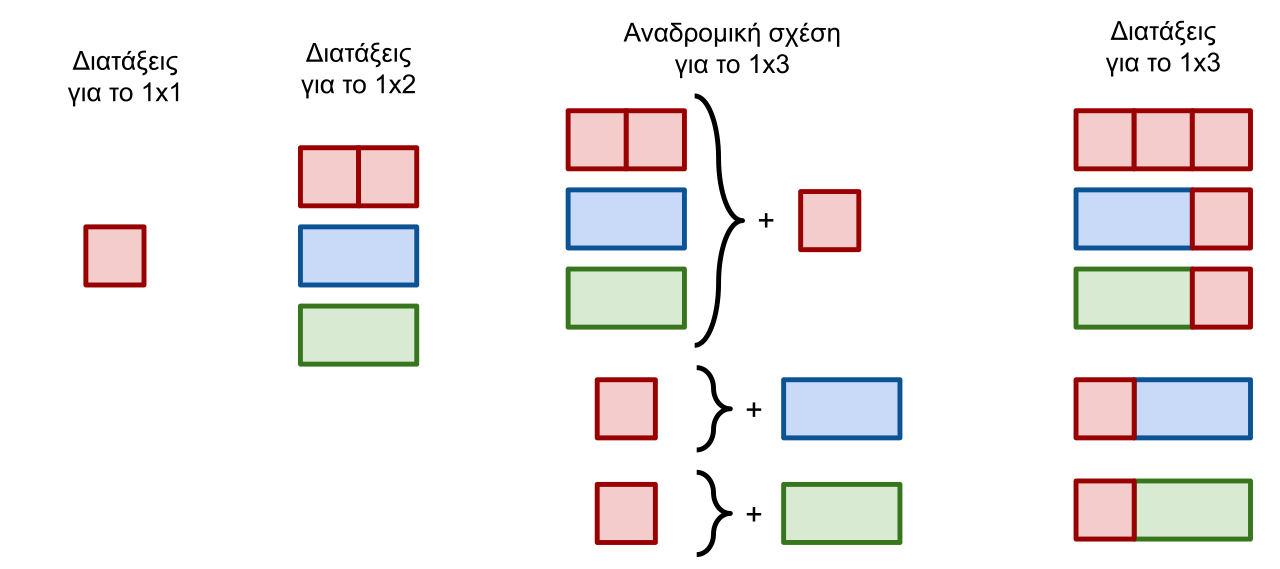
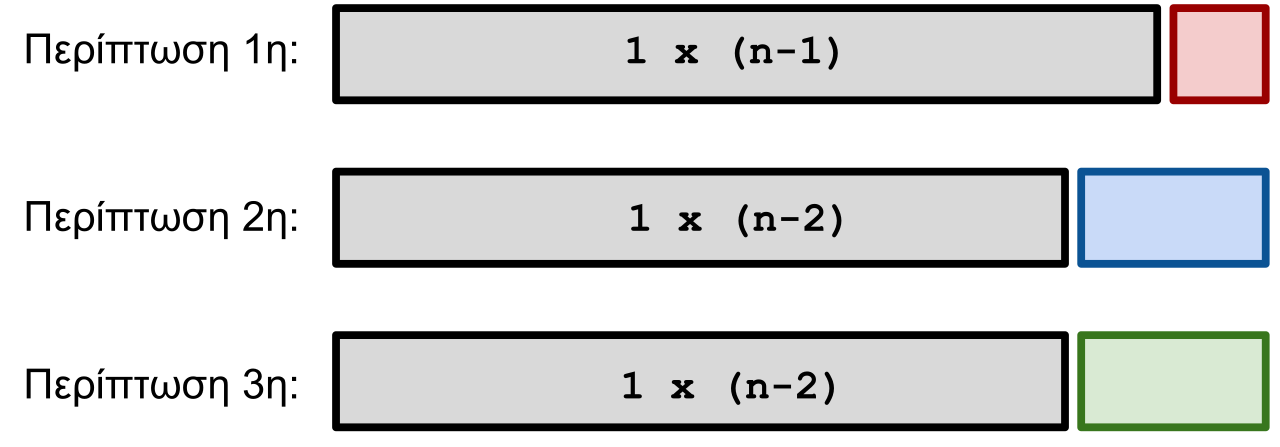
Many counting problems—paths on grids, arrangements, partitions—naturally produce a recurrence that captures the combinatorial structure. Solving or bounding that recurrence then gives closed-form answers or growth rates, making it the bridge between a combinatorial description and a computable formula.
More in Combinatorics 1-24
Spotted an error? Know more?
This is a living reference — every entry is fact-audited, and reader corrections feed straight into our audit queue. Suggest an edit · See this site's audit record