
Binomial (polynomial)
A polynomial consisting of exactly two monomial terms.

Wobble · Public domain
In algebra, a binomial is a polynomial that is the sum of two terms, each of which is a monomial. It is the simplest kind of sparse polynomial after the monomials. Binomials are fundamental in algebraic structures such as toric ideals and binomial ideals, and they appear in various factoring formulas and expansions.
- field
- Algebra
- known_for
- Sum of two monomials; basis of toric ideals and binomial ideals; factoring patterns such as difference of squares and sum/difference of cubes
Lore & Background
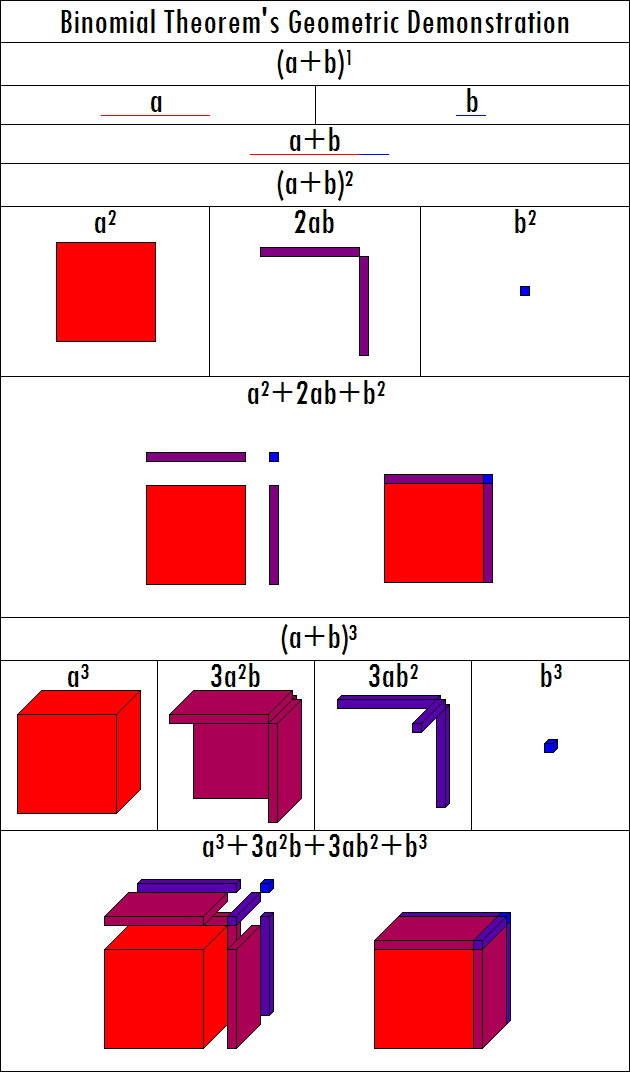
A binomial can be written in a single indeterminate as ax^m − bx^n, where a and b are numbers, and m and n are distinct non-negative integers. In the context of Laurent polynomials, a Laurent binomial allows exponents m and n to be negative. More generally, a binomial may involve multiple variables: a x₁^{n₁}⋯x_i^{n_i} − b x₁^{m₁}⋯x_i^{m_i}. Examples of binomials include 3x − 2x², xy + yx², 0.9x³ + πy², 2x³ + 7, and 11x − 2x². The binomial x² − y², the difference of two squares, factors as (x − y)(x + y). This is a special case of the formula x^{n+1} − y^{n+1} = (x − y)∑_{k=0}^{n} x^k y^{n−k}. Over complex numbers, x² + y² can be expressed as x² − (iy)² = (x − iy)(x + iy). The product of a pair of linear binomials (ax + b) and (cx + d) yields a trinomial: acx² + (ad + bc)x + bd. A binomial raised to the nth power, (x + y)^n, can be expanded using the binomial theorem or Pascal's triangle. For example, (x + y)² = x² + 2xy + y², with coefficients (1, 2, 1) from Pascal's triangle. Sums or differences of cubes factor as x³ + y³ = (x + y)(x² − xy + y²) and x³ − y³ = (x − y)(x² + xy + y²).
Reader's Guide
Binomials are central to algebra as the simplest non-monomial polynomials. They form the building blocks of toric ideals, which are generated by binomials whose coefficients are 1 and −1, and of toric varieties defined by such ideals. For any admissible monomial ordering, the minimal Gröbner basis of a toric ideal consists only of differences of monomials, a consequence of Buchberger's algorithm. Binomial ideals, which are generated by monomials and binomials (with relaxed coefficient constraints), also have minimal Gröbner bases containing only monomials and binomials. The inclusion of monomials in the definition of a binomial ideal is necessary because, for example, if a binomial ideal contains y − x and y − 2x, it also contains (y − x) − (y − 2x) = x. Binomials appear in practical factoring formulas, such as the difference of squares and sum/difference of cubes, and in the generation of Pythagorean triples via the (m, n)-formula: for m < n, let a = n² − m², b = 2mn, and c = n² + m²; then a² + b² = c². Their expansion via the binomial theorem and Pascal's triangle is a foundational tool in combinatorics and algebra.
Did You Know?
- A toric ideal is generated by binomials that are differences of monomials with coefficients 1 and −1.
- The minimal Gröbner basis of a toric ideal consists only of differences of monomials.
- The product of two linear binomials (ax + b) and (cx + d) is a trinomial: acx² + (ad + bc)x + bd.
- The binomial x² − y² factors as (x − y)(x + y), a special case of the formula x^{n+1} − y^{n+1} = (x − y)∑_{k=0}^{n} x^k y^{n−k}.
Defining the Structure
A polynomial sequence is a family of polynomials indexed by the nonnegative integers 0, 1, 2, 3, and so on, governed by a defining constraint: the index assigned to each polynomial equals its degree. This elegant correspondence between position and degree gives the sequence a natural ordering that mirrors the growth of polynomial complexity. These sequences occupy a central place in several branches of mathematics. They are a topic of active interest in enumerative combinatorics, where counting problems often produce polynomial expressions of increasing order. Algebraic combinatorics draws on them as well, using their structural properties to encode relationships among combinatorial objects. Beyond pure mathematics, applied mathematics relies on polynomial sequences for modeling and approximation tasks. The interplay between these fields means that a single polynomial sequence can carry meaning in a physics laboratory, a statistics textbook, and a combinatorics proof simultaneously, making it one of the most versatile constructs in the mathematical toolkit.
A Cross-Disciplinary Gallery of Examples
The breadth of polynomial-sequence examples reveals just how widely they permeate mathematical science. In physics and approximation theory, several families emerge naturally as solutions to ordinary differential equations. The Laguerre, Chebyshev, Legendre, Zernike, and Jacobi polynomials all belong to this group, each tailored to particular physical or numerical contexts. Statistics contributes its own notable entry in the Hermite polynomials, which play a key role in probability and data analysis. The algebra and combinatorics tradition offers an even longer roster: monomials, rising and falling factorials, all-one polynomials, Abel polynomials, Bell polynomials, Bernoulli polynomials, cyclotomic polynomials, Dickson polynomials, Fibonacci polynomials, Lagrange polynomials, Lucas polynomials, spread polynomials, Touchard polynomials, and rook polynomials. This extraordinary variety underscores that polynomial sequences are not a single niche topic but a unifying thread connecting differential equations, probability, number theory, and discrete mathematics into one coherent framework.
Taxonomic Families and Structural Classes
Mathematicians have organized polynomial sequences into several recognized classes, each capturing a distinct structural or algebraic property. Polynomial sequences of binomial type form one such family, named for their connection to binomial-like expansion rules. Orthogonal polynomials constitute another major class, defined by the property that distinct members are orthogonal under a given inner product. Secondary polynomials, Sheffer sequences, Sturm sequences, and generalized Appell polynomials round out the principal categories. These classifications are not merely taxonomic; they reflect deep algebraic relationships and determine which operations—such as differentiation, composition, or multiplication—preserve the family. The existence of multiple overlapping classes means that a given polynomial sequence may belong to more than one category simultaneously, revealing layers of structure that a single label would miss. This taxonomic richness is what makes polynomial sequences a fertile ground for both theoretical exploration and practical application across the mathematical sciences.
Theoretical Roots and Foundational Literature
The study of polynomial sequences is deeply intertwined with umbral calculus, a symbolic algebraic framework that treats polynomials as if they were generated by a single indeterminate variable. This connection is significant enough that umbral calculus is consistently listed as a closely related topic in the broader literature. Several foundational texts anchor the subject. Martin Aigner's A Course in Enumeration, published by Springer in 2007, addresses polynomial sequences within the wider context of enumerative methods. Steven Roman's The Umbral Calculus, issued by Dover Publications in 2005, provides a dedicated treatment of the symbolic techniques that underpin much of the theory. S. Gill Williamson's Combinatorics for Computer Science, also from Dover Publications in 2002, brings polynomial sequences into the realm of discrete mathematics as applied to computing. Together, these works illustrate that polynomial sequences sit at a crossroads of enumeration, symbolic algebra, and computer science, rewarding study from multiple complementary angles.
Gallery
Frequently Asked Questions
What is a binomial (polynomial)?
A binomial is a polynomial made up of exactly two monomial terms added together. Think of it as the most basic multi-term polynomial you can form, sitting just above single-term monomials in complexity.
What role do binomials play in algebraic structures?
Binomials serve as the building blocks for toric ideals and binomial ideals, two central objects in algebraic geometry and commutative algebra. Their two-term structure makes them the simplest non-trivial generators for these ideal families.
What factoring patterns are associated with binomials?
Classic identities like the difference of squares and the sum or difference of cubes all hinge on binomial expressions. These patterns let you break a product of two binomials back into its simpler factors.
Why are binomials called the simplest sparse polynomials after monomials?
A monomial has one term, and a binomial has exactly two, so it is the first polynomial with more than one piece. Any polynomial with three or more terms is already more complicated, making the two-term case the natural next step in sparsity.
How do binomials differ from general polynomials?
Where a general polynomial can have any number of monomial terms, a binomial is restricted to precisely two. This tight constraint is what gives binomials their special algebraic properties and makes them tractable in ways denser polynomials are not.
More in Combinatorics 1-24
Elsewhere in the Combinatorics universe
Spotted an error? Know more?
This is a living reference — every entry is fact-audited, and reader corrections feed straight into our audit queue. Suggest an edit · See this site's audit record