
Binomial coefficient
Positive integers that appear as coefficients in the binomial theorem.

Cmglee · CC BY-SA 4.0
Binomial coefficients are the positive integers that occur as coefficients in the binomial theorem. Commonly indexed by a pair of integers n ≥ k ≥ 0, they are written as \(\tbinom{n}{k}\) or \(C(n,k)\). They represent the coefficient of the \(x^k\) term in the polynomial expansion of \((1 + x)^n\), and can be computed using a multiplicative formula or factorial notation.
- field
- Mathematics
- known_for
- Coefficients in the binomial theorem; building blocks of Pascal's triangle; used in combinatorics
Lore & Background
Binomial coefficients are defined for integers n ≥ k ≥ 0 and are written as \(\tbinom{n}{k}\) or \(C(n,k)\). They are the coefficients of the \(x^k\) term in the expansion of \((1 + x)^n\). For example, the expansion of \((1 + x)^4\) yields coefficients 1, 4, 6, 4, 1, which correspond to \(\tbinom{4}{0}, \tbinom{4}{1}, \tbinom{4}{2}, \tbinom{4}{3}, \tbinom{4}{4}\). The coefficient \(\tbinom{4}{2}\) equals 6, computed as \(\frac{4 \times 3}{2 \times 1} = \frac{4!}{2!2!} = 6\).
Reader's Guide
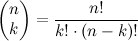
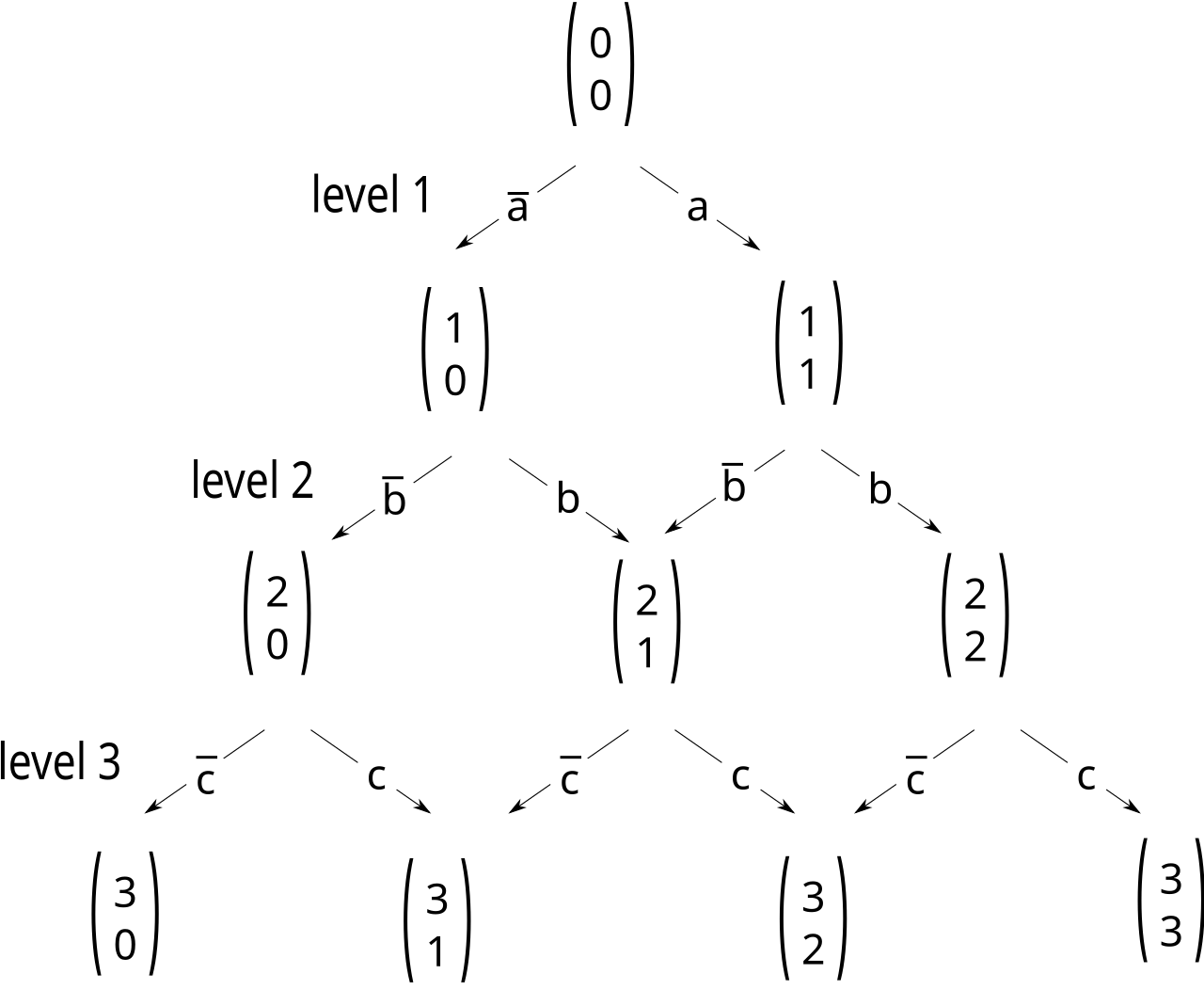
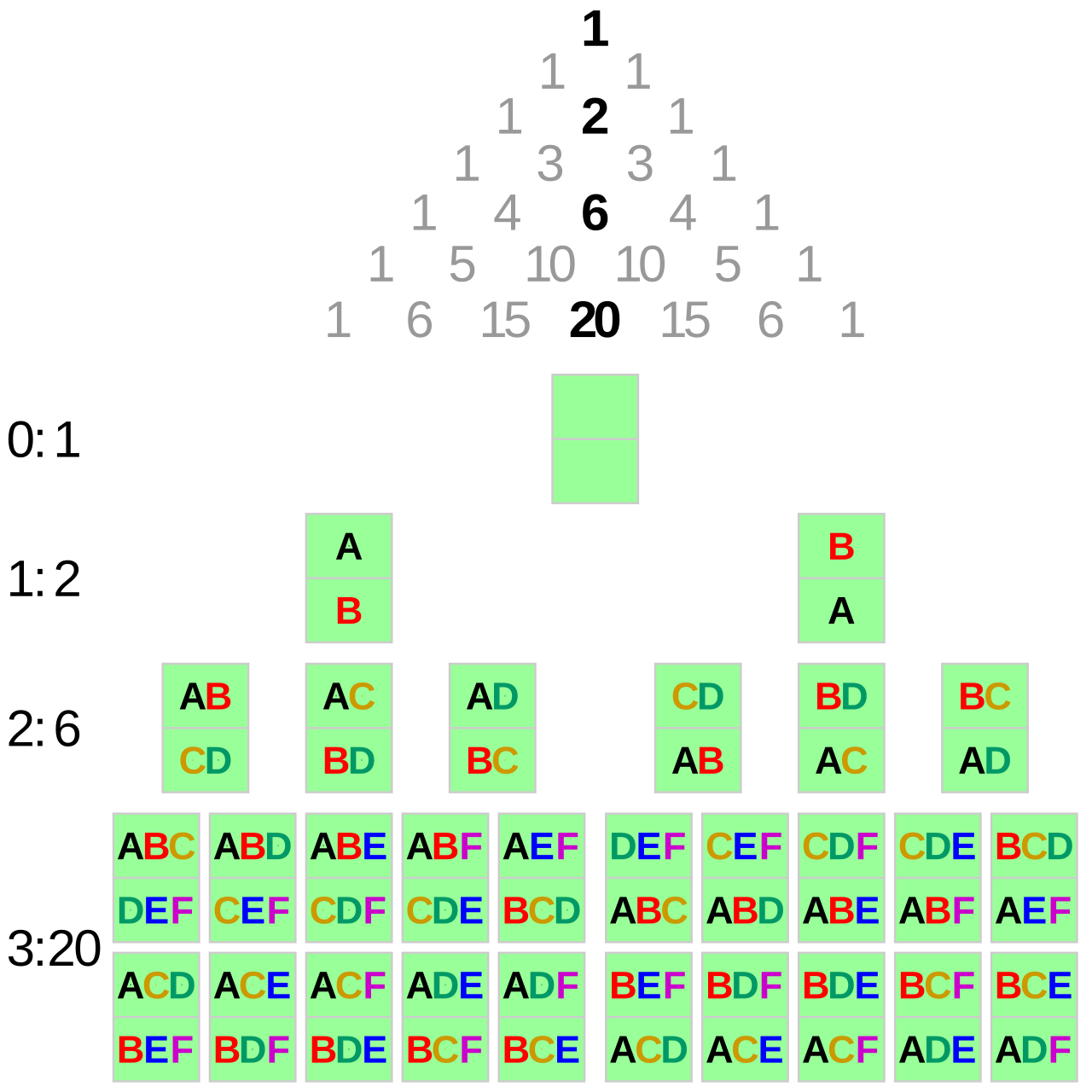
Binomial coefficients are fundamental in mathematics, especially in combinatorics. They are the positive integers that appear as coefficients in the binomial theorem, providing the expansion of powers of binomials like \((1 + x)^n\). Their computation via factorial notation \(\frac{n!}{k!(n-k)!}\) or the multiplicative formula allows for efficient calculation. Arranging these coefficients for successive n yields Pascal's triangle, a triangular array that satisfies the recurrence relation \(\tbinom{n}{k} = \tbinom{n-1}{k-1} + \tbinom{n-1}{k}\). This recurrence highlights their combinatorial significance, as they count combinations and appear in probability, algebra, and number theory. The example of \((1 + x)^4\) illustrates their use: the coefficients 1, 4, 6, 4, 1 correspond to the binomial coefficients for n=4. Their properties and recurrence make them a cornerstone of combinatorial reasoning and polynomial expansions.
Did You Know?
- Binomial coefficients are the positive integers that occur as coefficients in the binomial theorem.
- They are commonly indexed by a pair of integers n ≥ k ≥ 0 and written as \(\tbinom{n}{k}\) or \(C(n,k)\).
- The coefficient \(\tbinom{4}{2}\) equals 6, computed as \(\frac{4 \times 3}{2 \times 1} = \frac{4!}{2!2!}\).
- Arranging binomial coefficients for n = 0, 1, 2, ... gives Pascal's triangle, which satisfies the recurrence \(\tbinom{n}{k} = \tbinom{n-1}{k-1} + \tbinom{n-1}{k}\).
Identity, Naming, and Notation
The Gaussian binomial coefficient carries a remarkable collection of names—Gaussian coefficients, Gaussian numbers, Gaussian polynomials, and q-binomial coefficients—all referring to the same mathematical object. These are q-analogs of the classical binomial coefficients, meaning they generalize the familiar "n choose k" expression into a polynomial setting. The notation typically appears as [n k]_q or (n k)_q, with the subscript q signaling the parameter that governs the generalization. Rather than yielding a single number, the Gaussian binomial coefficient produces a polynomial in q whose coefficients are all integers. This polynomial nature elevates the object beyond a mere counting formula: it encodes a whole family of values parameterized by q, with the classical binomial coefficient recovered as a special case. The variety of names reflects the object's appearances across different branches of mathematics, from combinatorics to algebraic geometry, where each community has adopted its preferred terminology for the same underlying construction.
Counting Subspaces in Finite Geometry
When the parameter q is specialized to a prime power, the Gaussian binomial coefficient acquires a concrete geometric interpretation. Specifically, [n k]_q evaluated at such a q counts the number of k-dimensional subspaces within an n-dimensional vector space over the finite field F_q. This is equivalent to counting the points of the finite Grassmannian Gr(k, F_q^n), a central object in algebraic geometry over finite fields. The connection is not merely numerical: the polynomial structure of the Gaussian binomial coefficient means that as q varies over different prime powers, the same polynomial produces the correct subspace count for each corresponding finite field. This gives the object a deep unifying role—a single algebraic expression simultaneously encodes the geometry of subspaces across an infinite family of finite fields. The requirement that q be a prime power for the counting interpretation underscores the intimate link between finite field theory and the combinatorics of the Gaussian coefficients.
Why a Rational-Looking Formula Yields a Polynomial
At first glance, the defining formula for the Gaussian binomial coefficient looks like a rational function: a product of terms (1 − q^m)(1 − q^(m−1))⋯(1 − q^(m−r+1)) in the numerator divided by (1 − q)(1 − q²)⋯(1 − q^r) in the denominator. Yet the result is always a genuine polynomial with integer coefficients, because the division is exact in the ring Z[q]. The key to understanding this lies in the q-number [k]_q, defined as the sum 1 + q + q² + ⋯ + q^(k−1). Every factor in both the numerator and denominator is divisible by (1 − q), and after factoring these out, the expression rewrites as a product of q-numbers. For q ≠ 1, the q-number takes the closed form (1 − q^k)/(1 − q), while at q = 1 it simply equals k. This decomposition reveals why the apparent singularity at q = 1 is removable: the polynomial remains well-defined for every value of q, and the q-number provides the natural building block from which the entire Gaussian binomial coefficient is assembled.
Boundary Cases and the Classical Limit
The Gaussian binomial coefficient behaves with clean, predictable logic at its boundary cases. When the lower index r exceeds the upper index m, the value is defined to be zero, mirroring the classical convention that one cannot choose more items than are available. When r equals zero, the value is exactly one, since both the numerator and denominator reduce to empty products—there is precisely one way to select a zero-dimensional subspace. The parameter q = 1 represents a critical degeneracy: the q-number [k]_q collapses to the ordinary integer k, and the entire Gaussian binomial coefficient reduces to the classical binomial coefficient. This recovery of the familiar "n choose k" formula at q = 1 confirms that the Gaussian binomial coefficient is a true generalization rather than an unrelated construction. The piecewise definition of the q-number—rational expression for q ≠ 1, simple integer for q = 1—ensures that no division by zero occurs and that the polynomial remains well-defined across all values of the parameter.
Gallery
Frequently Asked Questions
Who is Binomial coefficient?
Binomial coefficient is the positive integer that appears as a coefficient in the binomial theorem's polynomial expansion. It is indexed by a pair of integers n ≥ k ≥ 0 and is most often written as C(n,k) or the 'n choose k' symbol.
What are Binomial coefficient's powers/role?
Its core function is to supply the exact coefficient of the x^k term when (1+x)^n is expanded. It also acts as the fundamental building block of Pascal's triangle and underpins a vast range of combinatorial counting problems.
How does Binomial coefficient's story end?
As a mathematical object it has no narrative conclusion, but its influence is permanent: every row of Pascal's triangle and every term in a binomial expansion still relies on it. It remains a go-to tool whenever one needs to count subsets or expand polynomials.
Why is Binomial coefficient important?
It gives a clean, computable answer to the central combinatorial question of how many ways you can select k items from a set of n. Its multiplicative and factorial formulas make it one of the most frequently invoked tools in all of combinatorics.
Where does Binomial coefficient first appear?
It emerges directly from the binomial theorem, which describes how (1+x)^n breaks into a sum of terms. Arranging those coefficients row by row produces Pascal's triangle, a structure with roots stretching back to ancient Chinese mathematics.
More in Combinatorics 1-24
Elsewhere in the Combinatorics universe
Spotted an error? Know more?
This is a living reference — every entry is fact-audited, and reader corrections feed straight into our audit queue. Suggest an edit · See this site's audit record