
Binomial theorem
Describes the expansion of powers of a binomial.

Cmglee · CC BY-SA 3.0
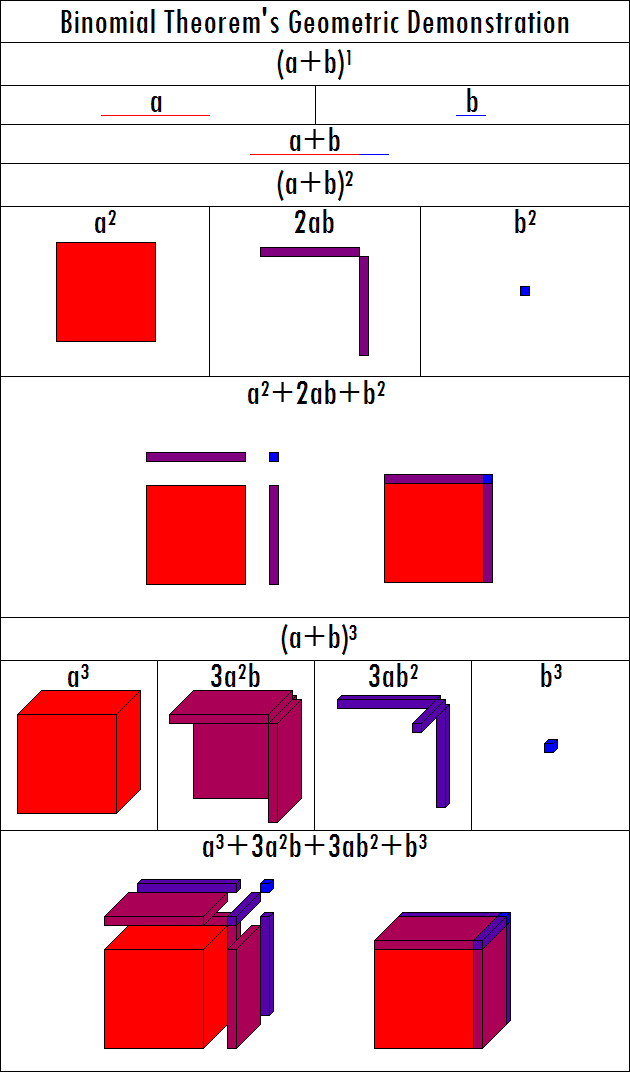
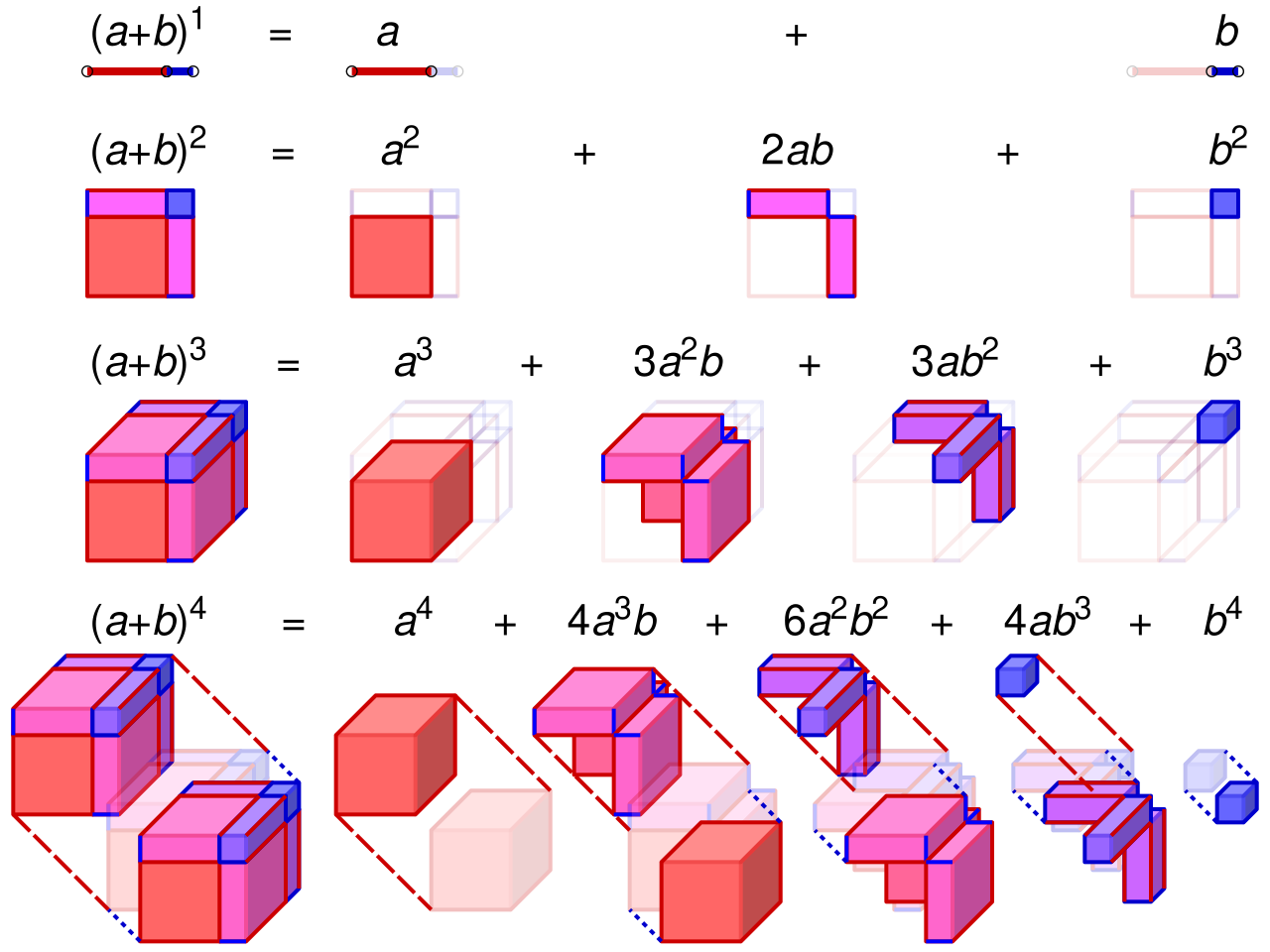
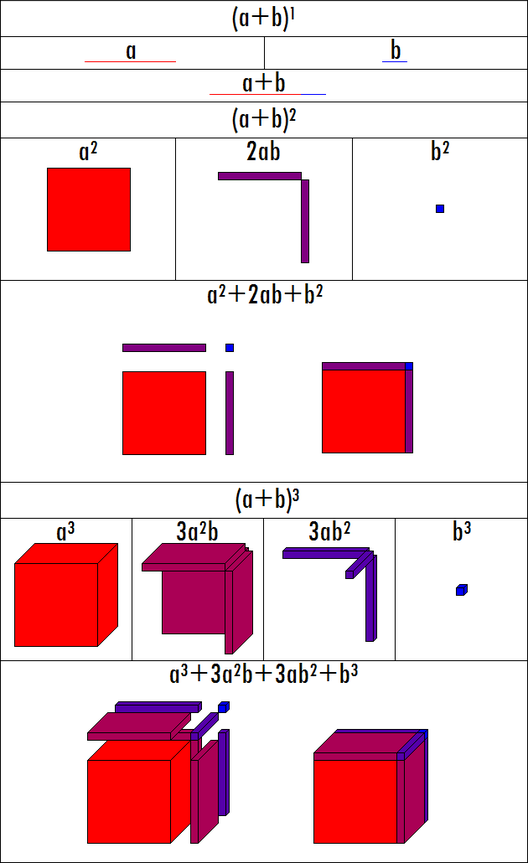
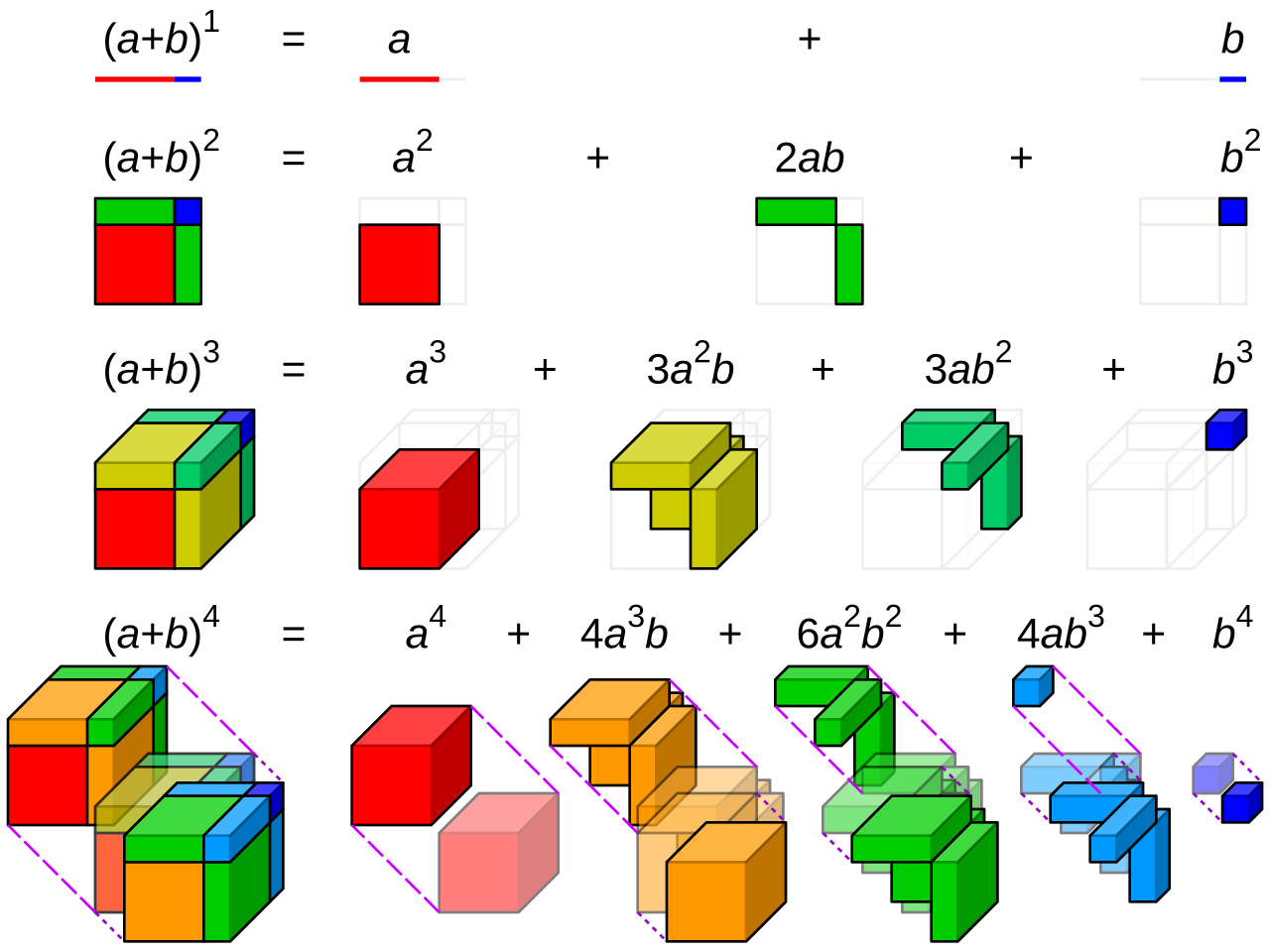
The binomial theorem (or binomial expansion) describes the algebraic expansion of powers of a binomial. According to the theorem, the power (x + y)^n expands into a polynomial with terms of the form a x^k y^m, where the exponents k and m are nonnegative integers satisfying k + m = n and the coefficient a of each term is a specific positive integer depending on n and k.
- field
- Elementary algebra
- known_for
- Algebraic expansion of powers of a binomial, binomial coefficients, Pascal's triangle
Lore & Background
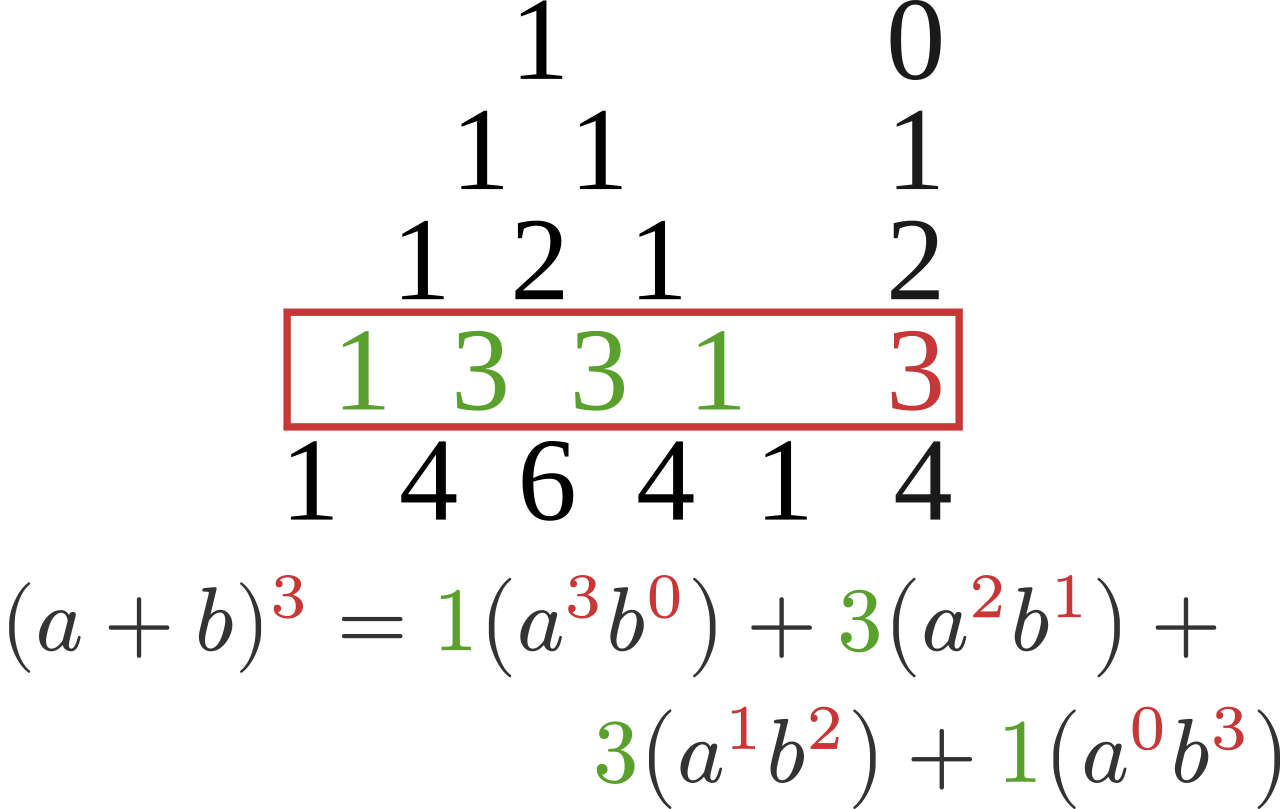
The binomial theorem states that for any nonnegative integer power n of the binomial x + y, the expansion is a sum of terms of the form (n choose k) x^(n−k) y^k, where the binomial coefficient (n choose k) is a positive integer. For example, for n = 4, (x + y)^4 = x^4 + 4x^3 y + 6x^2 y^2 + 4x y^3 + y^4. These coefficients can be arranged to form Pascal's triangle.
Reader's Guide
The binomial theorem is significant because it provides a systematic method for expanding binomials raised to any nonnegative integer power. The binomial coefficients (n choose k) that appear in the expansion are defined as n!/(k!(n−k)!) and also occur in combinatorics, where they give the number of different combinations (subsets) of k elements that can be chosen from an n-element set. This connection between algebra and combinatorics makes the theorem a foundational tool in both fields. The theorem is often written concisely using summation notation as (x + y)^n = Σ_{k=0}^n (n choose k) x^(n−k) y^k.
Did You Know?
- The binomial theorem describes the algebraic expansion of powers of a binomial.
- The coefficients in the expansion are known as binomial coefficients and can be arranged to form Pascal's triangle.
- The binomial coefficient (n choose k) gives the number of different combinations of k elements from an n-element set.
- The theorem can be written concisely using summation notation.
The Architecture of the Expansion
The multinomial theorem provides a precise recipe for expanding a sum of m variables raised to the nth power. Rather than producing a single term or a simple pair of terms, the expansion generates a collection of monomials, each built from the original variables raised to various exponents. The governing constraint is elegant: in every single term of the result, the exponents assigned to x1, x2, and so on through xm must collectively sum to exactly n. The summation runs over every possible combination of nonnegative integers k1 through km that satisfies this additive requirement. This means the number of terms in the expansion grows combinatorially as m increases, and the theorem gives a systematic way to enumerate them all without omission or duplication. The framework applies for any positive integer m and any nonnegative integer n, making it a universally applicable algebraic identity.
The Multinomial Coefficient at the Heart
At the center of each term in the multinomial expansion sits a numerical factor known as the multinomial coefficient. It is computed by taking the factorial of the total exponent n and dividing by the product of the factorials of each individual exponent k1, k2, through km. This single fraction encodes how many distinct ways the n factors in the original product can be distributed among the m variables to yield the specific monomial at hand. The coefficient is not arbitrary; it emerges naturally from the combinatorics of assigning n identical slots to m labeled categories. When you multiply this coefficient by the corresponding product of powers x1^k1 · x2^k2 · … · xm^km, you obtain one complete term in the expanded form. The entire expansion is simply the sum of all such terms across every valid index combination.
Generalizing the Binomial Theorem
The multinomial theorem is, at its foundation, a direct generalization of the binomial theorem. The binomial theorem handles the special case where the sum contains exactly two terms, and its expansion involves binomial coefficients. The multinomial version lifts this restriction, allowing the sum to contain any positive number m of terms. When m is set equal to two, the multinomial coefficient n!/(k1!k2!) collapses precisely into the familiar binomial coefficient, and the summation constraint k1+k2=n reproduces the standard binomial expansion. This relationship positions the binomial theorem not as a standalone result but as the simplest member of an infinite family of analogous identities. The multinomial framework thus unifies what might otherwise appear as separate algebraic formulas under a single, coherent principle that scales gracefully from two terms to any finite number.
Reading the Trinomial Cube
A concrete illustration of the multinomial theorem appears when expanding the cube of the trinomial a + b + c. The result contains ten distinct terms: three pure cubes (a³, b³, c³), six mixed terms of the form 3a²b, 3a²c, 3b²a, 3b²c, 3c²a, 3c²b, and one fully mixed term 6abc. One could derive this by repeatedly applying the distributive property and collecting like terms, but the multinomial theorem offers a more structured path. Each coefficient can be read off directly from the exponent pattern using the formula n!/(k1!k2!k3!). For instance, the coefficient 6 in front of abc corresponds to 3!/(1!·1!·1!), while the coefficient 3 in front of a²b corresponds to 3!/(2!·1!·0!). This demonstrates how the theorem turns a tedious multiplication exercise into a straightforward combinatorial lookup.
Gallery

Frequently Asked Questions
Who is Binomial theorem?
The binomial theorem is a foundational result in elementary algebra that tells you exactly how to expand any power of a two-term expression such as (x + y)^n. It guarantees the result is a polynomial in which every term's exponents sum to n, and each coefficient is a specific positive integer determined by n and the term's position.
What are Binomial theorem's powers/role?
Its core role is to break down (x + y)^n into a sum of terms of the form a·x^k·y^m, where k and m are nonnegative integers satisfying k + m = n. The coefficient a in each term is a binomial coefficient, a positive integer that depends only on n and k.
How does Binomial theorem's story end?
The expansion always terminates after exactly n + 1 terms, running from the pure x^n term down to the pure y^n term. The final entry is simply y^n carrying a coefficient of 1, closing out the symmetric sequence of binomial coefficients.
Why is Binomial theorem important?
It supplies a closed-form, systematic way to compute powers of sums without resorting to repeated multiplication, making it a workhorse in algebra, probability, and combinatorics. Its coefficients also generate Pascal's triangle, tying the theorem directly to counting problems and polynomial identities.
What is Binomial theorem's connection to Pascal's triangle?
The coefficients that appear when expanding (x + y)^n are precisely the entries in the nth row of Pascal's triangle. This means the theorem gives an algebraic reading of the recursive addition rule that builds the triangle row by row.
More in Combinatorics 1-24
Elsewhere in the Combinatorics universe
Spotted an error? Know more?
This is a living reference — every entry is fact-audited, and reader corrections feed straight into our audit queue. Suggest an edit · See this site's audit record