
Binomial series
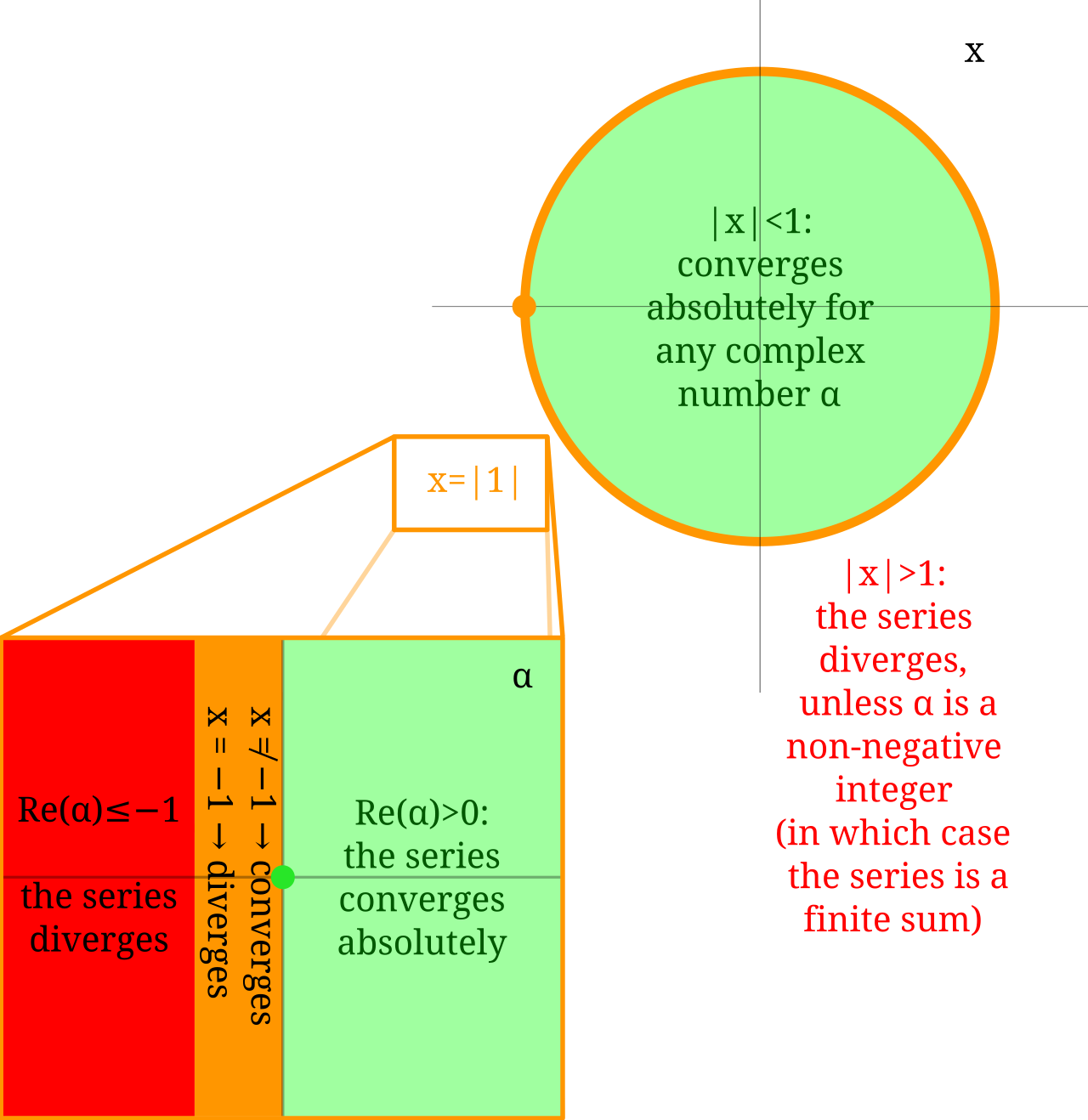
Generalized binomial formula for complex exponents.

Dalba · CC BY-SA 4.0
The binomial series is a generalization of the binomial formula to cases where the exponent is not a positive integer. It is the MacLaurin series for the function f(x) = (1+x)^α, where α is any complex number, and converges when |x| < 1.
- field
- Mathematics
- known_for
- Generalization of the binomial formula to complex exponents; MacLaurin series for (1+x)^α
Lore & Background
The binomial series expresses (1+x)^α as a power series in terms of generalized binomial coefficients, defined as (α choose k) = α(α-1)(α-2)...(α-k+1)/k!. When α is a nonnegative integer n, the series reduces to a finite polynomial, equivalent to the standard binomial formula. The series converges absolutely for |x| < 1 for any complex α, and its convergence at the boundary |x| = 1 depends on the real part of α.
Reader's Guide
The binomial series is significant as it extends the elementary binomial theorem to all complex exponents, providing a power series representation for functions of the form (1+x)^α. Its convergence properties are precisely characterized: absolute convergence for |x|<1; conditional or absolute convergence on |x|=1 depending on Re(α); and divergence for |x|>1 unless α is a nonnegative integer. The series is foundational in analysis, linking to the gamma function through asymptotic formulas for binomial coefficients. Its study illustrates key concepts such as radius of convergence, absolute versus conditional convergence, and the behavior of power series on the boundary of their disk of convergence.
Did You Know?
- The binomial series converges absolutely for |x| < 1 for any complex number α.
- If α is a nonnegative integer n, the series is a finite polynomial with all terms beyond x^n equal to zero.
- For |x| = 1 and x ≠ −1, the series converges if and only if Re(α) > −1.
- The generalized binomial coefficient is defined as (α choose k) = α(α−1)(α−2)⋯(α−k+1)/k!.
From Finite Formula to Infinite Series
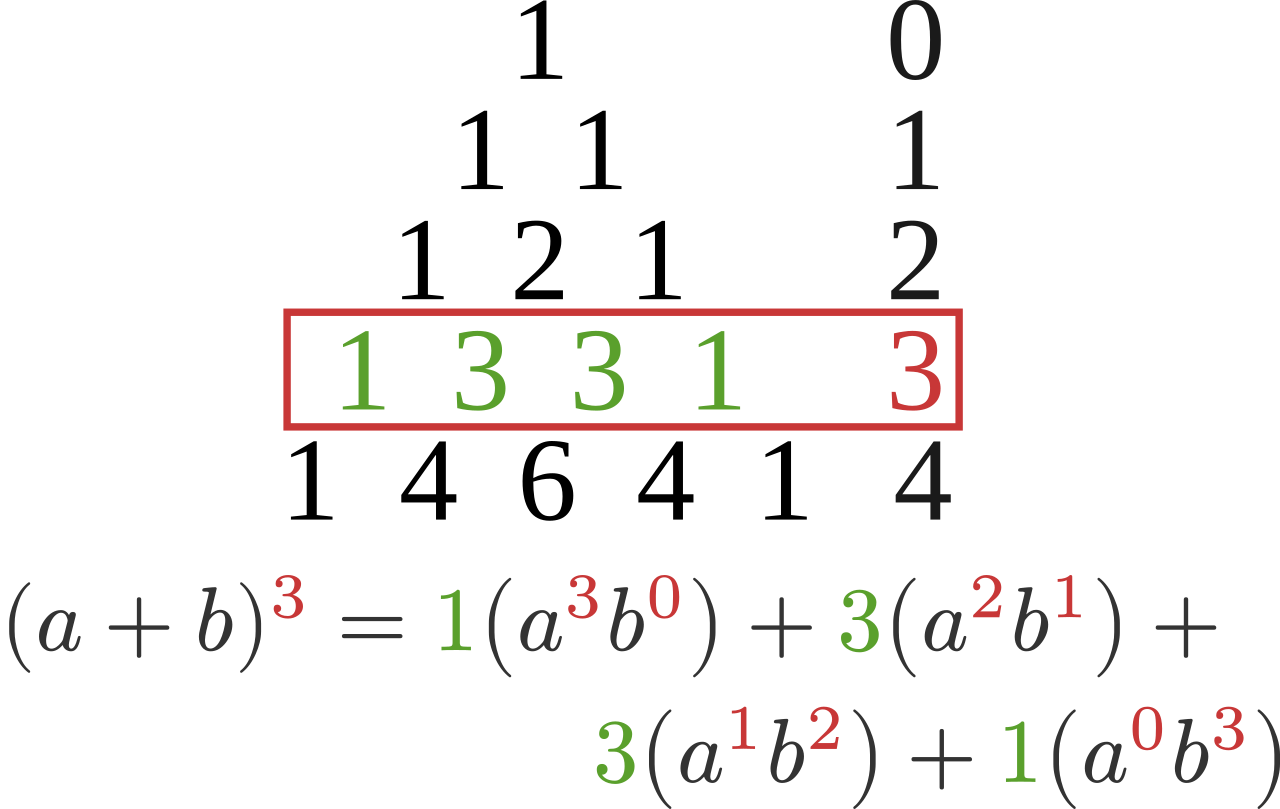
The binomial series represents a fundamental leap in algebraic thinking: it takes the well-known binomial formula, which applies only when the exponent is a positive integer, and extends it to any complex number α. The resulting expression is a power series whose coefficients are the generalized binomial coefficients, defined as the product of α, (α−1), (α−2), …, (α−k+1), all divided by k!. This series serves as the MacLaurin expansion of the function f(x) = (1+x)^α. When α happens to be a nonnegative integer n, something remarkable happens: every term from the x^(n+1) term onward vanishes, because each such term contains a factor of (n−n) = 0. The infinite series collapses into a finite polynomial, recovering exactly the classical binomial formula. Thus the binomial series unifies the finite and infinite cases under a single framework, with the integer case emerging as a natural special instance rather than a separate theorem.
The Convergence Landscape
The behavior of the binomial series across the complex plane reveals a rich and layered set of conditions. Inside the unit disk, where |x| < 1, the series converges absolutely no matter what complex value α takes. Outside this disk, where |x| > 1, the series diverges unless α is a nonnegative integer, in which case it is merely a finite sum with no convergence question to ask. The most intricate situation arises on the boundary where |x| = 1. Here, absolute convergence holds if and only if the real part of α exceeds zero, or α equals zero. When x is not equal to −1, conditional convergence becomes possible provided Re(α) > −1. However, at the specific point x = −1, the threshold tightens again to require Re(α) > 0 or α = 0. If Re(α) ≤ −1, the series diverges at every boundary point without exception.
Analytical Machinery Behind the Proof
Establishing the convergence results for the binomial series draws on several elegant analytical tools working in concert. To demonstrate that the radius of convergence equals exactly 1 whenever α is not a nonnegative integer, one applies the ratio test in conjunction with an asymptotic estimate for the generalized binomial coefficients. This asymptotic relationship is, in essence, equivalent to Euler's classical definition of the Gamma function, which expresses Γ(z) as a limit involving k!, k^z, and the product z(z+1)⋯(z+k). From this, one derives upper and lower bounds on the binomial coefficients using positive constants m and M. The boundary convergence results then follow by comparison with the p-series ∑ 1/k^p, where the exponent p is set to 1 + Re(α). For the case x ≠ −1 on the boundary, an additional algebraic identity is invoked to reduce the problem to the already-established absolute convergence criterion.
The Critical Point and Conditional Convergence
The point x = −1 on the unit circle plays a uniquely restrictive role in the convergence of the binomial series. While other boundary points, where |x| = 1 but x ≠ −1, permit conditional convergence whenever Re(α) > −1, the point x = −1 demands the stricter condition that Re(α) > 0 or α = 0. This asymmetry arises because the structure of the series at x = −1 interacts differently with the asymptotic decay rate of the binomial coefficients. For values of α where −1 < Re(α) ≤ 0, the series at x = −1 simply fails to converge, even though it would converge conditionally at neighboring boundary points. The proof of this exclusion again relies on the asymptotic bounds for the generalized binomial coefficients, showing that the terms do not decay sufficiently fast to produce a convergent sum at this particular location on the circle.
Gallery


Frequently Asked Questions
Who is Binomial series?
Binomial series is the MacLaurin expansion of (1+x)^α for any complex exponent α, making it the infinite-series counterpart to the finite binomial formula. It lives in the Combinatorics 1-24 slot as the entry that bridges discrete counting with continuous analysis.
What are Binomial series's powers/role?
Its core ability is expanding (1+x)^α into an infinite sum of coefficient-weighted powers of x, even when α is fractional or complex. This lets it handle cases the original binomial theorem simply cannot reach.
How does Binomial series's story end?
The expansion is only valid inside the unit disk, meaning it converges when |x| < 1. Step outside that radius and the terms blow up, so the series' arc is strictly bounded by that boundary.
Why is Binomial series important?
It unifies the finite binomial expansion (a special case at positive-integer α) with a single infinite-series framework usable across analysis, probability, and combinatorics. Without it, fractional and complex powers of (1+x) would lack a systematic expansion tool.
What is Binomial series's backstory/origin?
It grew directly out of the classical binomial theorem, which only works for non-negative integer exponents. By promoting the exponent to an arbitrary complex parameter α, the series extends the formula into infinite territory and recovers the old finite result as a limiting case.
More in Combinatorics 1-24
Elsewhere in the Combinatorics universe
Spotted an error? Know more?
This is a living reference — every entry is fact-audited, and reader corrections feed straight into our audit queue. Suggest an edit · See this site's audit record